
Mallampati Score to Help Predict Obstructive Sleep Apnea
As part of the initial exam done by Dr. Hirschinger in his Beverly Hills office, he will look into your mouth to evaluate you for obstructive sleep apnea. One of the things he is evaluating is the opening of your airway. This is also an assessment done by anesthesiologists when they evaluate your airway prior to any surgery that involves intubation to add or remove fluids to or from your stomach during surgery. When you open your mouth, there are certain structures that can cause the airway to narrow or be constricted. These structures are:
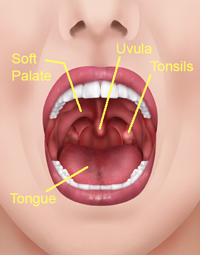
Soft palate: The soft palate is so named because it lacks a bony component. The area in front of the soft palate is the hard palate, since it contains bone. One of the functions of the soft palate is to close off the nasal passages during swallowing.
Tongue: The tongue is mostly muscle, and it is the primary organ of taste.
Tonsils: The tonsils are collections of lymphoid tissue that can become enlarged when infected, a condition known as tonsillitis. When they become enlarged, it can become more difficult to breathe through the mouth because the airway narrows.
Uvula: Uvula means “little grape” in Latin, and it is the small piece of tissue that hangs down from the edge of the soft palate.
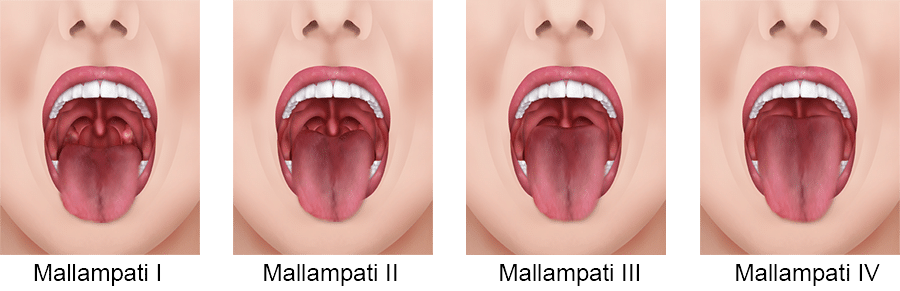
Mallampati I
With the tongue extended, when we look inside, if we can see the bottom of the uvula, we score that as Mallampati I since the airway is very open.
Mallampati II
With the tongue extended, when we look inside, if the tongue is covering part of the uvula, we score that as Mallampati II since the airway is mostly open.
Mallampati III
With the tongue extended, when we look inside, if the tongue is covering most but not all of the uvula, we score that as Mallampati III since the airway is mostly closed.
Mallampati IV
With the tongue extended, when we look inside, if the tongue covers all of the uvula, we score it as Mallampati IV, since the airway is very closed.